The main difference between a goods-only platform and a platform with attendant is that the former is designed exclusively for transporting goods, while the latter allows one or more operators to accompany the load when the work process requires it. This decision influences the applicable regulations, safety measures, and facility design.
One of the first questions any architect, engineer, specifier or elevator installer must resolve is whether the equipment will transport goods exclusively, or if it will be necessary for one or more operators to accompany the load during its travel.
This difference determines the way of working, the necessary safety systems, the installation requirements, and the applicable regulatory framework.
At Hidral, we have solutions designed for both scenarios. The EH range is intended for the exclusive transport of goods, while the EHM model allows up to two operators to accompany the load. These are not just two distinct configurations, but two ways of organising the logistics process.
Two philosophies: moving goods vs. moving goods with people
Before studying the technical characteristics of the project, it is necessary to analyse how the daily work will be developed.
Does the load get introduced into the goods platform and picked up on another floor? Or does the operator need to remain with the carts, materials, or equipment during the travel?
The answer allows for the differentiation of two main types of solutions.
The exclusive goods platform
A goods-only goods platform is designed to move loads between different levels without people inside the cabin or on the platform.
The operator carries out loading and unloading tasks from the plants but never accompanies the material during its travel. This configuration is particularly suitable for repetitive movements, defined logistical circuits, and processes where the load does not require supervision during transit.
The EH model (https://hidral.com/cargas-de-menos-de-2000kg/ ) from Hidral embodies this philosophy. It is designed for moving heavy or bulky loads and can be configured, depending on the project, to facilitate access for pallet trucks or goods platform. Its main objective is to offer robust, continuous, and efficient transport.
- Use cases: warehouses, logistics centres, factories, and heavy industry
The EH model is particularly suitable for installations with a constant flow of materials, including:
- Warehouses with repetitive movements between levels.
- Logistics centres and distribution platforms.
- Factories and production plants.
- Industrial facilities.
- Order picking zones.
- Areas designated for the movement of heavy or bulky loads.
- In these environments, the equipment can be integrated into an operational circuit where one worker deposits the goods at a plant, and another worker, or the same operator via a different travel, collects them at the destination level.
- Advantages: robustness, load capacity and continuous productivity
Among its main benefits are:
- Capacity utilisation.
- Configuration adapted to the type of goods.
- Robustness for demanding work environments.
- Simple operation.
- Optimisation of internal travels.
- Reduction of manual handling of loads.
- Continuity in industrial and logistic processes.
- This is a solution focused on the fast, robust, and consistent transfer of goods.
The platform with attendant
In other facilities, the work does not end when the load is deposited on the platform. The operator may need to check the material, accompany trolleys or equipment, prepare for unloading, or intervene immediately upon arrival at the destination plant.
In such cases, platforms specifically designed to transport both goods and people are used.
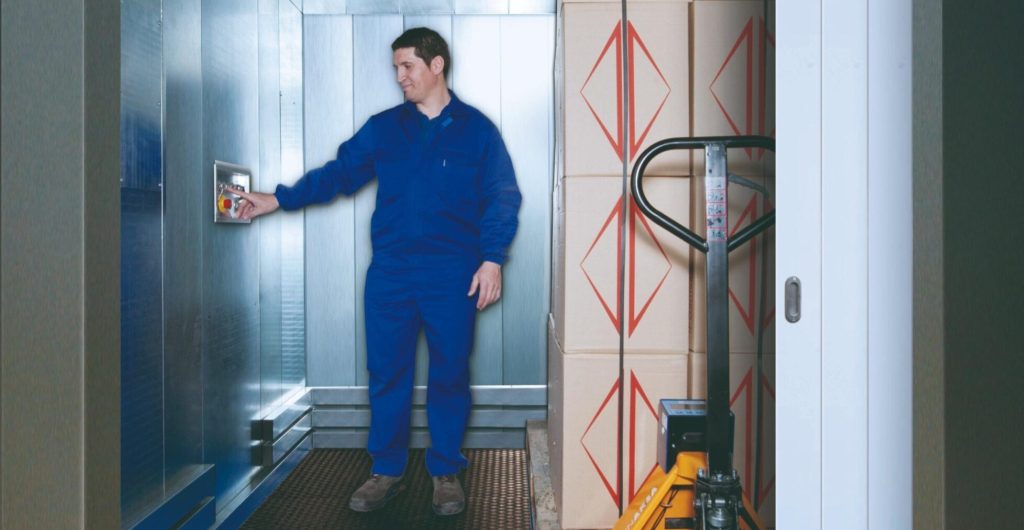
Hidral's EHM model (https://hidral.com/carga-acompanada-plataformas/) allows up to two operators to accompany the load. This capability improves the agility of certain logistics processes and avoids additional trips via stairs, corridors, or other platforms. Hidral also highlights the versatility of the EHM range, which can be used as a conventional goods platforms or in accompanied load mode, depending on the installation's needs.
- Use cases: hospitals, industrial laundries, supermarkets and production lines
EHM elevators are used in spaces where materials are typically moved by carts or equipment that require a worker's presence.
Some examples are:
- Hospitals and socio-sanitary centres.
- Industrial laundries.
- Hotels and serviced complexes.
- Large retail spaces and commercial establishments.
- Logistics centres.
- Production lines.
- Buildings where goods require constant supervision.
- Facilities with cleaning trolleys, clothing, food, tools, or sanitary materials.
In these applications, the worker can enter the trolley, accompany it during the travel and continue the operation upon arrival, without needing to look for an alternative travel.
- Advantages: load monitoring, agility, and saving travel time
The EHM is designed to optimise the operator's workflow, in addition to transporting goods.
Its main advantages are:
- Possibility of up to two operators accompanying the load.
- Material supervision during the tour.
- Greater agility in loading and unloading operations.
- Reduction of incidental travel.
- Better coordination in processes with trolleys or equipment.
- Greater comfort for the worker.
- Integration of specific security measures for people and goods.
This model can be particularly useful when the time spent travelling between floors directly impacts productivity or service quality.
The difference every prescriber must know: applicable regulations
The presence or absence of people during the tour is not a minor issue. It directly influences risk assessment, safety devices, compliance procedures, documentation, and post-commissioning obligations.
For this reason, the intended use must be defined from the early stages of the project.
Machinery only: Machinery Directive 2006/42/EC and new Regulation (EU) 2023/1230
Equipment designed exclusively for raising goods generally falls under European machinery regulations, depending on its characteristics.
Currently, Directive 2006/42/EC lays down the essential health and safety requirements for the marketing and putting into service of machinery within the European Union. In Spain, this directive was incorporated through Royal Decree 1644/2008.
The Machinery Directive expressly differentiates between equipment intended exclusively for goods from that where a person can access the cabin and use controls located within it or within their reach.
Regulation (EU) 2023/1230 will progressively replace Directive 2006/42/EC and establish an updated framework for the design, manufacture and marketing of machinery. The new regulation strengthens aspects such as risk assessment, traceability, documentation and the responsibilities of economic operators.
Therefore, when prescribing a goods platform, the following must be checked:
- The intended use stated by the manufacturer.
- The nominal load and the dimensions of the equipment.
- The access and drive system.
- Measures to prevent the transport of people.
- Risk assessment.
- The declaration of conformity and CE marking.
- Instructions for use and maintenance.
With people on board: safety requirements and regulatory classification
When a person can travel alongside the cargo, the risk level changes. The equipment must incorporate measures specifically designed to protect the occupants during access, transit, stops, and any potential emergency situation.
Directive 2014/33/EU governs elevators permanently installed in buildings and constructions intended for the transport of people, of people and goods or, in specific cases, of goods when the car is accessible and has controls within reach of a person inside it. In Spain, its requirements are developed through Royal Decree 203/2016.
However, not all accompanied freight elevators necessarily have the same classification. This will depend on factors such as speed, guidance system, cabin accessibility, control location, intended use, and the equipment's construction characteristics.
For this reason, the solution must be selected in accordance with the manufacturer's declared documentation and classification. It is not correct to alter the actual use of goods platform or to allow people access to equipment that has not been designed, evaluated, and certified for it.
The EHM incorporates a specific safety level for the combined transport of goods and up to two operators. It is designed precisely for processes in which human intervention is part of the work cycle.
CE Marking, legal responsibility and why a person should never travel on a goods platforms
The CE marking indicates that the manufacturer or, depending on the product, the installer, declares that the equipment meets the applicable requirements of the European harmonisation legislation. It is not a generic authorisation to use the equipment in any way.
Each goods platforms must be used in accordance with its intended purpose, its instructions and its declaration of conformity.
Allowing a person to travel on a goods platforms truck exclusively intended for goods means using the equipment outside of the conditions for which it was designed. In addition to creating a serious risk, this practice can alter the responsibilities of the owner, the installer, the maintenance company, and the other parties involved in the installation.
The decision must be made before defining the product
How to decide: criteria for architects and elevator engineers
The selection must be based on the actual operation of the installation and not solely on the available space or the requested load capacity.
Does the cargo require supervision during transit?
This is the main question.
When goods can move themselves and there is an organised system for loading and unloading them, an EH goods platforms is often the right choice.
When the operator needs to remain with the material, work with trolleys, prepare the discharge, or intervene immediately at the destination point, an EHM accompanied loading solution must be studied.
It is also advisable to analyse:
- The number of daily movements.
- The type of cargo.
- The presence of carts, pallet trucks or mobile equipment.
- The maximum foreseen weight.
- The dimensions of the goods.
- The number of operators involved.
- The current times of the process.
- Alternative travel available for staff.
You don't just buy a platforms; you define a way of working. This conceptual difference between EH and EHM must be part of the decision-making process from the outset.
Construction and installation requirements: pit, void, floor slabs and the Technical Building Code
Once the use has been defined, it is necessary to study the integration of the equipment into the building.
The project must consider the shaft dimensions, available pit depth, headroom, access points, floor load-bearing capacity, support points, loads transmitted to the structure, and electrical requirements.
The requirements of the Technical Building Code that are applicable to the property must also be reviewed, especially in matters such as:
- Structural safety.
- Fire safety.
- Safety of use.
- Accessibility, where applicable.
- Noise protection.
- Integration of facilities.
Needs vary between new builds and refurbishments. In existing buildings, having precise information on the shaft, stopping levels and structure allows for the study of tailored configurations and avoids unnecessary building modifications.
Early coordination between management, builder, platforms installer and manufacturer helps to correctly define clearances, access and structural loads before the shaft is executed.
Seek technical advice from Hidral and find the solution that best suits your project's needs.


