In restaurants and hotels, the vertical transport of dishes, food, tableware, trolleys, laundry, stock items, or internal merchandise is part of daily service operations. Having a Dumbwaiter or one forklift adapted to each need, it allows for the optimisation of workflows, improvement of staff safety and the streamlining of operations in environments of Hospitality.
In this article, we look at the main types of lifts for hotels and restaurants, how they differ, the factors to consider before choosing a solution, and the Hidral's proposals for HORECA projects.
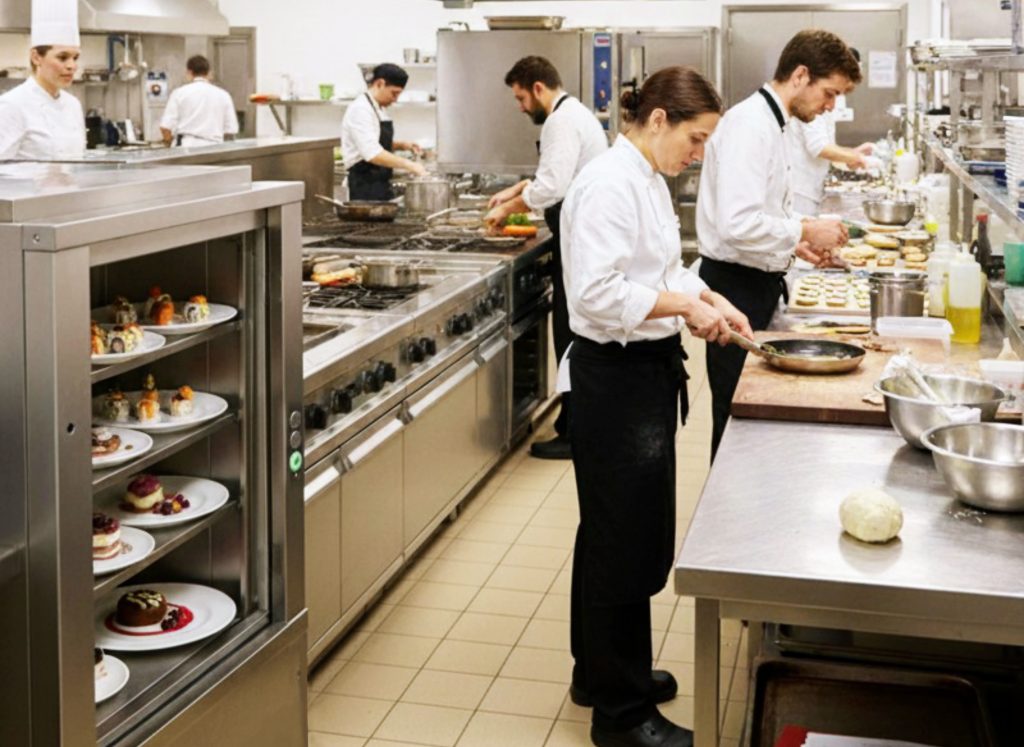
A dumbwaiter is a small lift used for transporting food and beverages between floors in a building. In the hospitality industry, they are commonly used in restaurants between the kitchen and dining areas to quickly and efficiently deliver orders without the need for staff to travel up and down stairs. They can also be used to transport dirty dishes back to the kitchen.
A Dumbwaiter It is a small-sized lift designed to transport food, tableware, trays, utensils, or small products between different levels of a building, always without human accompaniment.
In the hospitality sector, this type of solution enables efficient connection between areas such as the kitchen, dining room, staff room, storeroom, terrace, restaurant floor, or service areas when they are on different levels. Its installation helps to reduce manual travel up and down stairs, improve internal organisation, and speed up routine tasks like transporting prepared dishes, food, tableware, drinks, or small packages.
This type of equipment is also commonly found under designations such as food lift, dish lift o food lift. Although these terms are frequently used, it is important to differentiate between a dumbwaiter and a passenger lift: the former is intended exclusively for the transport of goods, while the latter is designed and certified for the movement of people.
Dish lifts, goods lifts and mini-lifts: what are the differences?
Although in everyday language they may be used similarly, there are important differences between Dumbwaiter, small loads y forklift. Choosing correctly from the outset allows you to avoid oversized installations or, conversely, solutions that are insufficient for the actual needs of the business. This decision is especially relevant in restaurants, hotels, and HORECA spaces, where the pace of work demands agile, safe equipment adapted to daily use.
The Dumbwaiter It is designed to transport small loads, such as plates, trays, food, crockery, drinks or utensils, between different floors. It is a very common solution in restaurants with kitchens and dining areas on different levels, cafés with basement storage, or establishments that need to streamline service without staff having to constantly climb stairs.
The small loads, or small and medium-capacity lifts, extend this range of use. In addition to food or crockery, they can be used to transport boxes, stock, kitchenware, small orders or ancillary equipment. They are a particularly versatile option when a business needs a solution with greater capacity than a traditional dumbwaiter, but does not require a large goods lift.
For its part, the forklift It is designed for larger or heavier loads. In the hospitality sector, it can be used to transport laundry trolleys, stock from the storeroom, cleaning products, parcels, crates of drinks or replacement supplies. In hotels, for example, it is particularly useful for connecting service areas, laundries, storerooms, kitchens, back-of-house areas or internal logistics areas.
The main difference between these pieces of equipment lies in the type of load they transport, their capacity, the dimensions of the cabin, platform or doors, as well as the way they are used. While a dumbwaiter meets lighter and more specific needs, a minilift offers greater flexibility for small and medium loads, and a goods lift is designed for more bulky or heavy merchandise.
Types of lifts for hotels and restaurants
Depending on the load and size
Not all lifting needs in the hospitality industry are the same. Transporting prepared dishes, trays, or crockery requires a different solution than what's needed for moving laundry carts, warehouse boxes, or restocking items.
For crockery, food, trays or small parcels, the usual choice is a Dumbwaiter or one Small kitchen lift. This type of equipment helps to streamline day-to-day operations, reduce travel and ensure smoother coordination between the different floors of the establishment.
When a business needs to transport trolleys, boxes, warehouse stock, cleaning products, or hotel laundry, it is advisable to consider a larger, higher-capacity forklift. Solutions such as the MTH model, designed for medium goods and especially useful in environments such as hotel laundries, warehouses, and light industrial buildings.
With or without driver
Dish lifts and goods lifts designed for kitchens, restaurants and hotels are goods-only lifts. In other words, they transport goods, but not people. However, there are situations in which staff need to travel alongside the goods to streamline operations, supervise the transfer or handle larger items.
In such cases, the appropriate solution is not a conventional dumbwaiter, but a lift accompanied cargo. The Model EHM The Hidral can be used as a standard forklift or in a mode where up to two operators can ride along, offering comfort, safety and efficiency in professional environments where operations require this type of movement.
Hidral Solutions for Hotels and Restaurants
Hidral has solutions tailored to the hospitality sector, with models designed for the transport of small loads, medium-sized goods, accompanied loads and people in confined spaces. The range is capable of meeting a wide variety of needs within restaurants, hotels, service buildings and commercial premises where lifting is part of daily operations.
Model MH: the versatile dumbwaiter for restaurant kitchens
The Model MH It is a forklift solution for small and medium loads. It is designed to facilitate vertical transport in service sectors and stands out for its adaptability to different projects.
One of its main advantages is the wide range of sizes available, as well as the option of wall-mounted or freestanding installation. This flexibility makes it a particularly attractive option for restaurant kitchens, cafés, bars and small hotels that require a practical, reliable solution tailored to the available space.
MTH model: medium-sized goods for hotels, laundries and warehouses
The MTH model It is designed for the vertical transport of medium loads, such as trolleys and hand-pulled carts, with flush-to-floor service. This feature facilitates the loading and unloading of cargo, especially when working with rolling items.
In hotels, laundrettes, warehouses, parcel rooms and service areas, the MTH allows for the optimisation of internal processes such as the movement of linen, cleaning products, restocking materials, orders or logistical goods. Its installation helps to reduce travel, improve working times and facilitate the team's daily operations.
EHM Model: when staff must ascend with the load
The Model EHM It is a supervised loading solution that is particularly useful when operations require the goods to travel with one or two operators.
In the hospitality sector, it can be a very suitable option for facilities where larger volumes of goods are moved, or where staff need to accompany the merchandise between floors for reasons of safety, control, or efficiency. Its versatility allows it to be used as a conventional freight elevator or as an accompanied loading hoist, adapting to different professional needs.
UHe Model: accessibility for hotels and HORECA buildings
The UHe model It is an electric lift designed for tight spaces and does not require a machine room. It is a suitable solution for homes, businesses, and public buildings and stands out for its minimal pit depth of 200 mm.
In hotels, restaurants, and HORECA buildings, the UHe can contribute to improving accessibility between floors when the primary need is not to transport goods, but to facilitate the movement of people. It is particularly interesting in renovations, existing buildings, or projects where available space is highly constrained.
What solution does your restaurant or hotel need?
Every HORECA project has specific needs. Transporting dishes between the kitchen and dining room is not the same as moving laundry carts, warehouse goods, or accompanied loads. Therefore, before choosing a dumbwaiter, miniload, or goods lift, it is essential to analyse the type of load, frequency of use, available space, number of stops, and building conditions.
At Hidral, we support every project from the initial consultation to after-sales service, offering lifting solutions tailored to the real needs of restaurants, hotels, and professional spaces.
Contact our team and we'll help you find the most suitable solution.


