In industrial, logistical, residential, or commercial projects, not all lifting systems respond to the same need. Choosing a traction lift it does not consist solely of defining a maximum load or a travel between floors: it involves analysing the actual use of the equipment, the type of user, the installation environment, the frequency of operation and the applicable technical and regulatory requirements.
A lift traction forklift, an lift traction car lift and one traction passenger lift They may appear similar solutions at first glance, as they all allow for vertical level changes. However, each is designed for a specific application and should be prescribed with different criteria.
At Hidral, we work to offer lifting solutions adapted to each project, supporting the professional from the technical definition phase through to the supply of equipment. Therefore, in this article, we'll help you distinguish between the main options available.
What is a traction lift and what role does it play in a technical project?
A traction lift It is a vertical lifting system operated by an traction system with a counterweight. Its primary function is to move loads, vehicles, or people between different levels of a building or facility, providing safety, efficiency, and operational continuity.
This type of solution can be integrated into multiple environments: industrial buildings, warehouses, car parks, shopping centres, residential spaces, logistics zones, public buildings, or facilities where there is internal transport of goods. It can also be key in accessibility, renovation, or mobility improvement projects within a building.
From a technical point of view, to speak of traction lift is to use a generic term. Within this category, different applications can be found: a traction forklift for goods, a traction car lift for vehicles or a traction passenger lift for safe user onboarding.
The choice will depend on factors such as the rated load, type of use, speed, travel, number of stops, available space, manoeuvre type, and the safety requirements demanded for each case. Furthermore, the traction drive can contribute to improving the Energy efficiency of the project, especially when a team is selected that is suitable for the actual use of the facility.
Industrial traction goods lift: when to choose one and what technical aspects to consider
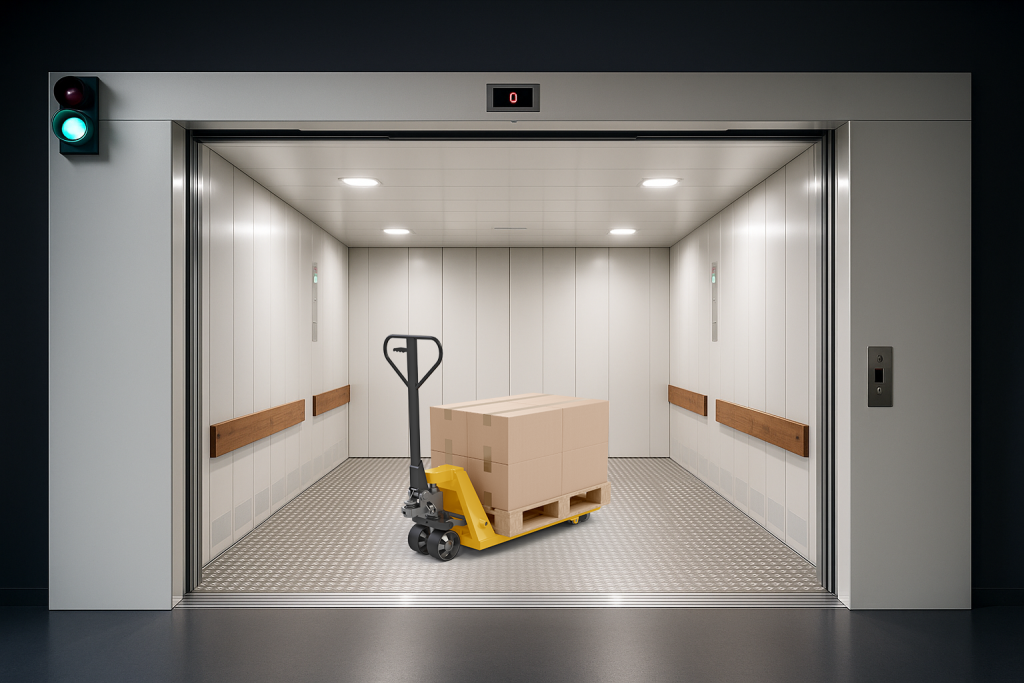
The traction goods lift The Hidral QHGe model is designed for the vertical transport of goods, materials or products accompanied by people. It is a solution particularly suited to environments where the load, equipment resistance and frequency of use are decisive for the daily operation of the activity.
A traction goods lift It can be installed in warehouses, factories, logistics centres, food premises, hotels, retail outlets, distribution centres, or buildings with constant internal movement of goods. In these cases, the objective is not just to move a load from one floor to another, but to do so safely, efficiently, and adapted to the pace of work in the space.
When choosing a Goods lift, it's worth considering several technical aspects:
The Payload o Rated load it is one of the first parameters that must be defined. It is not enough to calculate the usual weight of the goods: it is also important to anticipate possible load peaks, the use of forklifts or pallet trucks, and the distribution of weight on the platform or cabin.
Cabin dimensions are also key. They must be adapted to the type of goods being transported, the loading and unloading system, and the available space on site. Oversized equipment can unnecessarily increase the cost of the project, while insufficient equipment can limit daily operations.
Other relevant criteria include the travel distance, speed, number of stops, type of access – single or 180º boarding – the installation environment, and the usage conditions. It is not the same to specify a goods lift for a warehouse with intensive traffic as for an installation for occasional use or for a commercial building with architectural limitations.
Regarding regulations, it is important to analyse each case with prudence. Applicable compliance will depend on the type of equipment, its intended use, and whether or not there is permitted access for people. Therefore, having the manufacturer's support during the design phase helps to avoid prescription errors and to define a solution that is consistent with the technical and legal requirements of the installation.
Traction car lift: a solution for garages, car parks and buildings with limited space
The lift traction car lift from Hidral, QHVe model, allows vehicles to be moved between different levels when a traditional ramp is not viable, efficient, or excessively reduces usable space. It is a common solution in projects where every square metre counts and where access to parking must be resolved functionally and safely.
The Car lift must be designed taking into account the type of vehicle intended and its dimensions, available space, cabin dimensions, headroom, pit, manoeuvring, safety systems and frequency of use. In a garage with car lift, These factors influence both user comfort and equipment durability.
The width and length of the cabin, the available escape route, the access to the equipment, and the ease of manoeuvring within the car park must also be taken into account.
The value of an traction car lift is not solely in overcoming a height difference. It lies in optimising square metres, improving access, making parking easier, and providing a viable technical solution where a conventional ramp would represent a significant loss of usable space.
Traction passenger lifts: accessibility, safety and use in shopping centres
Unlike a forklift or a car lift, the Hidral QHPe traction passenger lift It is designed for the safe movement of users. Its prescription should address not only load, travel, or dimension criteria but also specific safety, comfort, accessibility, and user requirements.
The Heavy-duty traction passenger lift QHPe is designed for use in public buildings, commercial properties, social and healthcare centres, or offices. We also offer specific solutions for single-family homes with our model He which can be integrated into new build projects where comfortable, safe and universal mobility is sought from the outset, as well as into renovation projects where space is highly constrained.
The Universal accessibility is one of the main reasons to incorporate this type of solution. A traction lift UHe It allows for the removal of architectural barriers and facilitates the use of the building by people with reduced mobility, the elderly, families with prams, or users who need to move between levels more comfortably.
In this type of equipment, safety is a priority. Elements such as control systems, doors, emergency stop devices, limiters, guards, signage, and other applicable regulatory requirements may be involved depending on the case. The technical definition must consider the intended use, the environment, and the building's characteristics.
For architects, engineers, and technicians, a people-lifting solution adds value to both new builds and refurbishments. The ability to adapt to existing openings, reduce complex interventions, and improve building mobility makes these systems a particularly interesting alternative for projects where accessibility is a central objective.
How to choose the right solution during the project pase
Stop to choose an traction lift the project phase is crucial. A good Technical specification allows needs to be anticipated, subsequent modifications avoided, and ensures that the chosen solution is adapted to the actual use of the building or facility.
The first step is to define what is to be transported: goods, vehicles or people. This answer determines the type of equipment, safety systems, options, applicable regulations and the construction characteristics of the project.
Next, the main technical parameters must be specified: nominal load, useful dimensions, travel, number of stops, speed, frequency of use, type of access, available space, pit, overhead clearance, and environmental conditions. It is also important to consider how loading and unloading will be carried out, who will use the equipment, and what level of integration the installation requires.
In one Industrial lifting solution, for example, ensuring resistance, capacity and continuity of use may be a priority. In a car lift, the key may lie in manoeuvrability, cabin dimensions and parking optimisation. In a passenger lift, accessibility, safety and ease of use will be decisive factors.
Request a Technical lift offer with complete information facilitates decision-making. The more accurate the Technical specifications, the closer the manufacturer's proposal will be, and the lower the risk of deviations on site.
At Hidral, we support professionals throughout this process to define viable, safe, and tailored solutions for each requirement. Because every lifting project has its own specific constraints, and choosing correctly from the outset makes all the difference.
Regulations and safety in traction lifts
The Lift regulations in Spain it depends on the equipment's use and its technical classification. The same criteria do not apply to a goods-only lift, a car lift, an accessible platform or a lift intended for transporting people, and in all cases, it may fall within the scope of machine regulations or lift regulations.
Depending on the case, references related to the Forklift regulations, the Vehicle lift regulations, the Elevator regulations, the CE marked, machine safety or specific lift regulations. In Spain, for example, Royal Decree 355/2024 approves ITC AEM 1 “Lifts”, which regulates aspects such as the commissioning, modification, maintenance and inspection of lifts; and Royal Decree 1644/2008 establishes rules for the marketing and commissioning of machinery, including requirements linked to CE marking.
For this reason, it is essential not to generalise. The application of standards depends on the type of equipment, its intended use, the permitted access, the installation environment, and the project's characteristics. An incorrect definition in the initial phase can affect the design, technical documentation, safety, and commissioning.
Safety in lifts should not be seen as an add-on, but as an essential part of the project. Protection systems, controls, signage, emergency elements, access, enclosures and safety devices must be considered from the outset.
Having a specialised manufacturer allows the prescriber to work with greater confidence when defining the equipment. At Hidral, our aim is to support each client with a complete service: from initial advice to after-sales care, offering lifting solutions adapted to the real needs of each project.


