When a project needs to move vehicles between different plants, it is common to use terms such as car lift, vehicle platform lift, car lift, Car lift o vehicle lift to talk about the same solution. However, although these expressions are often used as synonyms, technically they do not always refer to the same type of product.
At Hidral, we distinguish between two main families of solutions for the vertical transport of vehicles:
- The vehicle platform lift, considered a lifting machine.
- The vehicle lift, designed as a lift integrated into the building.
The most important nuance is that Both solutions allow the vehicle to be transported with its occupants inside.. Therefore, the choice does not depend on whether people can accompany the car during the journey, but on other factors: the type of product, the load capacity, the required performance, the route, the drive, the application sector, and the degree of integration required in the building.
Hidral has a specific solution for every scenario, from dealerships, private garages and residential buildings to offices and public car parks. Correctly analysing the project's needs from the outset allows for the selection of the right equipment, optimisation of available space and avoidance of subsequent modifications during the construction phase.
What is a vehicle platform lift? The Hidral ECH vehicle platform lift
A car lift o vehicle platform lift it is a lifting machine designed to transport vehicles vertically between different levels.
The ECH from Hidral is notable for its great stability and its twin-column design. This configuration allows it to handle high loads and large platforms, providing robustness throughout the entire movement.
Among its main features are:
- Load capacity of up to 3,500 kg.
- Travel up to 7 metres.
- Platform with a width of up to 3 metres.
- Two-column hydraulic design.
- Vehicle transport with its occupants.
- Great stability during the journey.
The available width is one of the model's differentiating features. Reaching up to three metres allows it to adapt to vehicles of different dimensions and facilitates entry and exit manoeuvres, especially in projects where usable space must be maximised.
This vehicle platform lift can be installed in a wide variety of spaces and configurations. It is an especially suitable solution for dealerships, automotive-related businesses, residences, private garages, and projects with non-intensive vehicle traffic.
It is also suitable when the installation of a conventional ramp takes up too much space, compromises the building's layout, or is impractical due to the plot's configuration. The ECH allows for the freeing up of usable floor space and the vertical connection of different vehicle areas.
View all the features Hidral ECH car lift.
What is a vehicle lift? The QHV and QHVe vehicle lifts from Hidral
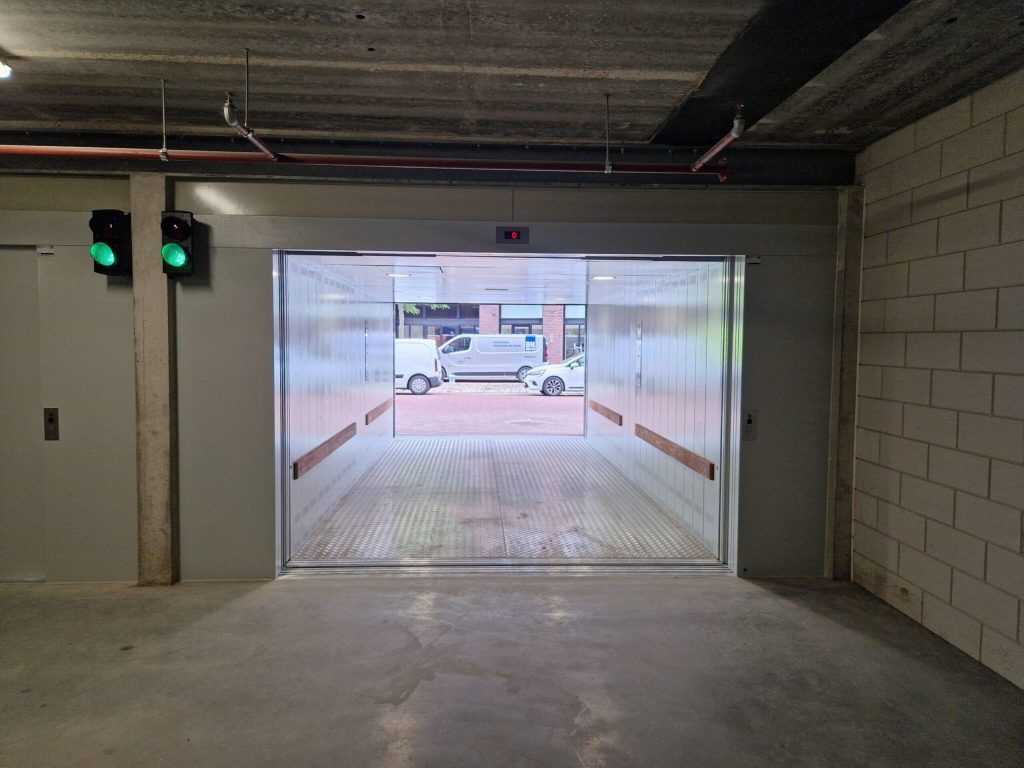
A vehicle lift is a lift in its own right, designed to transport vehicles and people between different floors and to be permanently integrated into the building.
Faced with the vehicle platform lift understood as a lifting machine, the vehicle elevator offers superior capabilities and features of a lift installation. For this reason, it is commonly used in residential buildings, offices, public car parks and other projects where space utilisation, architectural integration and service conditions are particularly important.
Hidral has two models within this family: the hydraulic QHV and the electric QHVe.
Hydraulic vehicle lift QHV
The QHV is Hidral’s hydraulic solution for the vertical transport of vehicles and people. It can handle a load capacity of up to 5,000 kg, making it suitable for projects involving heavier vehicles and with high operational demands.
In addition to its capacity, it can incorporate features that provide operational safety and service continuity:
- Vehicle centring system.
- Hydraulic central dual changeover.
- Emergency pump set.
- Different customisation possibilities.
The centering system helps to correctly position the car within the cabin. In turn, the double switched centre and the emergency motor pump unit provide additional resources to act in the event of a failure of the main system.
These features make the QHV a particularly interesting solution for residential buildings, offices, public car parks, and projects where a robust, configurable, and integrated lift is required for the property.
Electric vehicle lift QHVe
The QHVe is the electric version of Hidral's vehicle lift range. It achieves a load capacity of up to 6,000 kg and a speed of 1 m/s.
One of its main advantages is that it does not require a machine room. This feature simplifies the booking of technical spaces and offers greater freedom to architects, engineers, and specifiers during the building's layout.
The QHVe also incorporates an engine designed to maximise energy efficiency and offers the same customisation possibilities as the hydraulic range. This way, it combines high load capacity with speed, efficiency and design flexibility.
This model is particularly suitable for projects where the aim is:
- A high-performance electrical solution.
- Faster scrolling speed.
- Absence of a plant room.
- Energy consumption optimisation.
- Integration in residential buildings, offices, or public car parks.
- Customisation of finishes and configurations.
The QHV and QHVe models allow selection of the most suitable technology based on the building's characteristics, the required capacity, and the project's operational priorities.
Discover the range of QHV and QHVe vehicle lifts.
Vehicle platform vs. vehicle lift: key differences
The difference between vehicle platform lift and vehicle lift does not lie in the presence of people inside the vehicle. Both the ECH car lift and the QHV and QHVe elevators allow the car to make the journey accompanied by its occupants.
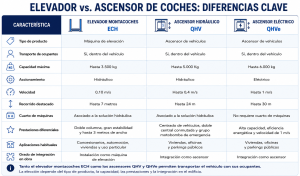
The main difference is found in the product category and in the way it must fit within the project.
COMPARATIVE TABLE
Regulations and safety
The regulations for a vehicle platform lift do not have to be the same as the regulations applicable to a vehicle lift. The corresponding reference depends on the category of the equipment, its characteristics, its speed, its intended use and the final configuration of the installation.
Generally speaking, the ECH vehicle platform lift is classified as a lifting machine, whilst the QHV and QHVe models are designed as lifts for vehicles and people.
In the European Union, machinery is currently governed by Directive 2006/42/EC. Regulation (EU) 2023/1230 will replace that directive with effect from 20 January 2027. Lifts and their safety components are regulated by Directive 2014/33/EU. The applicable provisions must always be determined on the basis of the specific characteristics of the project.
The CE marking indicates that the product has followed the relevant conformity assessment procedure within the applicable regulatory framework. It should not be understood as an isolated element, but as the result of a process that includes design, risk assessment, technical documentation, necessary verifications, and the declaration of conformity.
Safety in vehicle lifting begins before the equipment is manufactured or installed. Correctly defining the intended use, load, travel distance, access points, frequency of operation and product category is essential to avoid errors during the design phase.
Hidral’s products and services are backed by AENOR certification of its quality management system in accordance with the international standard ISO 9001. Furthermore, its technical team works alongside architects, engineering firms, installers and other professionals throughout the process of defining the solution.
The applicable regulations can vary depending on the country, building conditions, and equipment configuration. Therefore, each installation must be reviewed individually by the project's responsible professionals and by the manufacturer.
When should you choose each solution?
The choice should be made taking into account the intended use, the characteristics of the building and the required performance.
Choose the ECH vehicle platform lift when…
The ECH may be the most suitable solution when:
- A sturdy vehicle hoist is required.
- The required capacity does not exceed 3,500 kg.
- The planned range is up to 7 metres.
- A particularly wide platform is required.
- Stability and structural strength are priorities.
- The project is aimed at a car dealership or the automotive sector.
- This is a dwelling or a private garage.
- The aim is to replace a ramp and make better use of the space.
- A versatile solution is sought for a specific configuration.
Its twin-column design and width of up to three metres make the ECH a particularly practical option when platform dimensions and ease of manoeuvring are important considerations.
Choose the QHV vehicle lift when…
A hydraulic QHV may be the right choice when:
- A load capacity of up to 5,000 kg is required.
- The equipment must be integrated into the building as a lift.
- A robust hydraulic solution is required.
- A vehicle centring system is required.
- Redundancy must be provided by means of a dual switched exchange.
- The possibility of installing an emergency motor pump unit is being considered.
- The facility is located in a residential, office or public car park building.
The QHV combines capacity, customisation and additional operating resources, making it suitable for projects where service continuity and integration into the building are particularly relevant.
Choose the QHVe vehicle lift when…
The electric QHVe may be the right solution when:
- A capacity of up to 6,000 kg is required.
- A speed of up to 1 m/s is required.
- There is no space available for a machine room.
- Energy efficiency is a priority.
- An integrated lift is required in the building.
- The project is located in a residential block, an office building or a public car park.
- More frequent use or a journey is foreseen that would make higher speed particularly valuable.
For architects and specifiers, the QHVe offers an additional advantage: as it does not require a plant room, it provides more freedom in organising the building's technical spaces.
New builds and refurbishment
Whether in new builds or refurbishments, the solution must be considered from a global perspective.
In new builds, it's possible to reserve the shaft, pit, access points, and necessary installations from the outset. In renovations, however, it's usually necessary to work with existing constraints, making dimensional flexibility and technical advice even more important.
In both scenarios, replacing a ramp with a vehicle lift or a vehicle platform lift can free up considerable floor space. This space can then be used for new parking bays, communal areas, storage, or other uses that add value to the property.
There is no universal solution: there is a solution that is right for each project. At Hidral, we support architects, engineers, installers and lift professionals from initial consultation to after-sales service, helping them define the equipment that best meets their needs.
Check the available solutions:
Please tell us the features of your project, and our technical department will study the most suitable capacity, dimensions, drive, and configuration to offer you tailored advice and a quotation.


