What is professional elevation, really?
When talking about elevation, the first thing that comes to mind is a lift. A piece of equipment that moves people up and down between floors.
But for those who work in the sector (lift engineers, installers, engineering firms, maintenance technicians), professional elevation is rather more than just a piece of equipment.
It is the set of knowledge, technology and processes required to resolve the vertical mobility of people, goods and vehicles in buildings and facilities with very diverse characteristics.
And that is where what truly makes the difference between suppliers begins.
Because a residential building does not require the same solution as a hospital, a warehouse with heavy goods traffic, a car park with moving vehicles, or a refurbishment project where accessibility must be solved without altering the architecture.
Each scenario requires a different response. Although in all cases we are talking about elevation, none of them are adequately satisfied by resorting to a single catalogue option.
The project begins long before the team is chosen
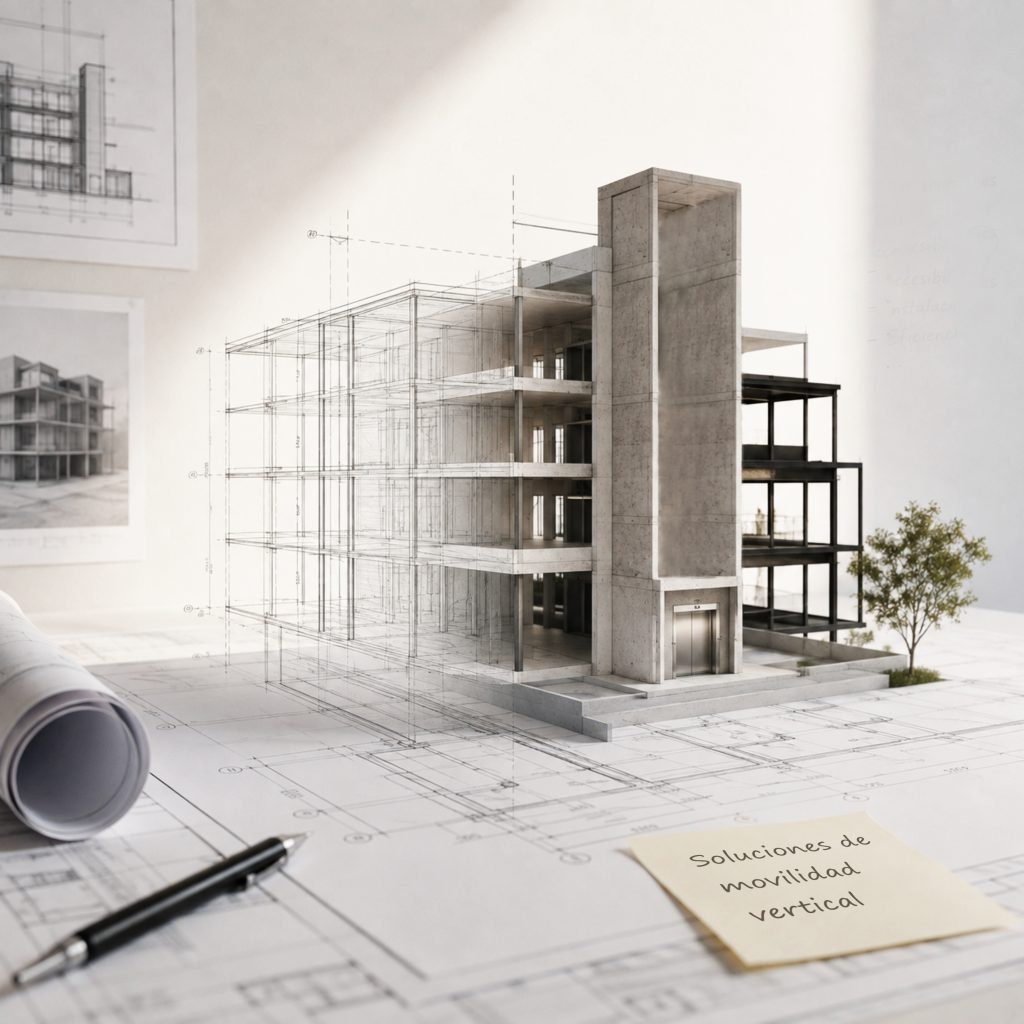
A lifting project doesn't start when the installer chooses a machine. It starts beforehand: by analysing usage, the building's characteristics, the available shaft space, the required performance, the applicable regulations, how it is going to be installed and how it will need to be maintained and evolve afterwards.
That is the difference between selling a lifting product and backing a professional solution. The equipment is one part. The project is everything else.
And many hands are involved in that project: specifiers, engineering firms, construction companies, installers, maintenance providers and the manufacturer. Each one contributes a part so that the system works on the day of commissioning and for the years that follow.
The sooner those decisions are finalised, the easier it is to integrate the solution on site, avoid modifications and facilitate maintenance or future modernisation.
For the installer, that translates to something very specific: fewer surprises on site and less risk to their own schedule.
Where the project changes depending on the building
There is no generic “professional uplift”. There are different decisions depending on the use. Some of the most common for the channel:
- Industrial units and logistics.When what is being moved is cargo, the focus is on capacity, robustness and duty cycles. It is the domain of industrial forklifts and freight lifts sized by weight and actual usage.
- Car parks and automotive.Moving vehicles between floors has its own dimension and manoeuvre rules. This is the case with the car lift.
- Residential and refurbishment.Tight spaces, pits and shafts that dictate everything. This is where machine room-less lifts (MRLs) come in, designed for demanding shafts.
- Accessibility. Overcoming a level change without altering the building, often in protected heritage. This is the realm of accessibility solutions.
In each of those cases, the installer is putting their client's project on the line. And that is where the manufacturer ceases to be a mere supplier of machinery.
The cost doesn't end on the day of installation
There is one factor that increasingly weighs on the decision: the life cycle.
The value of a lifting solution is not measured solely by what it costs to buy. It is measured by how it performs over years: reliability, ease of maintenance, availability of spare parts, ability to adapt to new needs and total cost of ownership.
For the maintenance engineer, this is an everyday occurrence: well-thought-out equipment with accessible spare parts is equipment that results in fewer call-outs and protects their relationship with the client.
Because the purchase price ends on the day of installation. The life of the solution, on the other hand, has only just begun.
Why this defines the manufacturer's role
Understanding professional elevation in this way changes the way the entire channel works.
It is no longer about finding a machine that fits in a gap. It is about understanding what the building needs, what use it will have, and what response it can provide today and in a few years' time.
And to give that answer, the installer needs more than just a catalogue: they need a manufacturer behind them.
A manufacturer that sizes the solution alongside you when the project goes beyond the standard. One that provides engineering, backing and support in design, manufacturing, installation and commissioning. One that broadens the range when the project demands it, rather than closing the door at the edge of the catalogue.
That is the role of HIDRAL S.A.: the specialist manufacturer behind the installer.
Talking about professional lifting is talking about engineering, architecture, regulations, installation, operation, maintenance and evolution.
And above all, of understanding that every project needs a solution tailored to its reality and a manufacturer willing to build it with you.
That is what turns a lifting equipment into a professional solution.
Do you have a non-standard project? Ask us for specifications and we will scope it out with your technical team.
FAQ Professional elevation
What is professional elevation?
It is the set of knowledge, technology and processes required to resolve the vertical mobility of people, goods and vehicles in buildings and facilities. It goes beyond the equipment: it includes the analysis of use, the building, regulations, installation and maintenance throughout its entire useful life.
What factors need to be taken into account before choosing a lifting equipment?
The intended use, characteristics and building space, required performance, applicable regulations, installation method, and how it must be maintained and modernised in the future. Finalising these decisions early reduces on-site modifications and facilitates subsequent maintenance.
Why does the lifecycle matter just as much as the purchase price?
Because the total cost of a lifting solution depends on its reliability, ease of maintenance, spare parts availability and adaptability, a cheaper solution to buy can turn out more expensive to run.
What does the manufacturer provide to the installer in a lifting project?
Reliable product, engineering to size bespoke solutions, and support in design, manufacture, installation and commissioning. In non-standard projects, a specialist manufacturer broadens the scope rather than being limited to the catalogue.


